#CharlotteAl-Khalili
Discovering the past among the rubble: Returning to Daraa
by Charlotte Al-Khalili (University of Sussex)
After being forced to leave Lebanon as the Israeli army intensely bombed Beirut where we had settled a year earlier; after yet another forced displacement, my husband started to long even more for going back home to Syria. It was October 2024 and when he told me about his dream to buy a house in his hometown of Daraa, I wondered aloud who would ever live in this house since we might not be able to access the country until our late fifties! Yet, a couple of months after this conversation, on December 8, 2024, the Assad regime fell and it all changed.
What does it mean to return home after a defeated revolution and a decade of war? What does it mean to regain hope in a (revolutionary) future and to end a forced exile one did not think might end before one’s lifetime? But also, what does it mean to do ethnographic work in the context of extreme political violence?
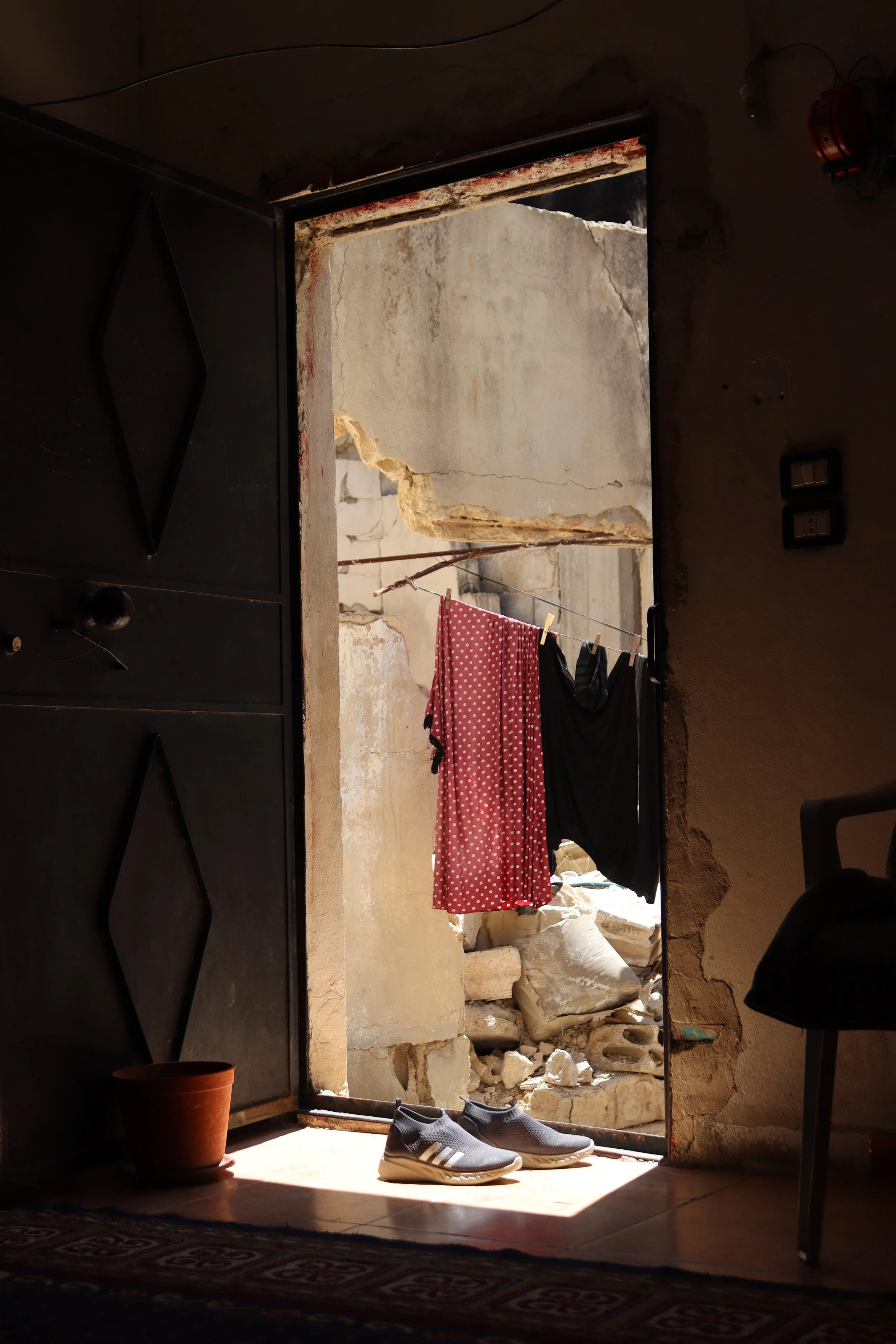
Going back home
Following the downfall of the Syrian regime, my interlocutors, friends, family and I could finally enter Syria without fear for the first time after a decade-long forced displacement in Turkey and Lebanon.
This photo essay is a deeply personal one, as it proposes to follow my family – my husband’s return to his hometown, and my discovery of it with my kids – after thirteen years of exile. This visual journey through the city of Daraa (Southern Syria) shows a devastated land – one in ruins, marked by urbicide and despair – but also a transformed landscape, with revolutionary emblems and symbols quickly replacing those of the fallen regime, and showing signs of hope and a new beginning. The ruins are bursting with life.
It documents homecoming, reuniting with family and introducing those born in exile to those who stayed in the homeland. It is a journey to the personal and familial past, as well as to the revolutionary past; it is also a personal and political journey that brings the viewer to the cityscape through the eyes of a family that was scattered by the violent repression of the 2011 revolution.
This text focuses on the city of Daraa, considered the birthplace of the revolution by many, for it saw the first significant protests in the country on March 18, 2011, following the arrest, detention and violent torturing of boys who had dared to write on their school’s wall,“the people want the fall of the regime” and “it’s your turn doctor”, echoing the Egyptian revolution’s slogans. The protests that started in Daraa al-balad were directly met with violent repression, and protesters were shot at with live ammunition, causing the death of several people from the first days.
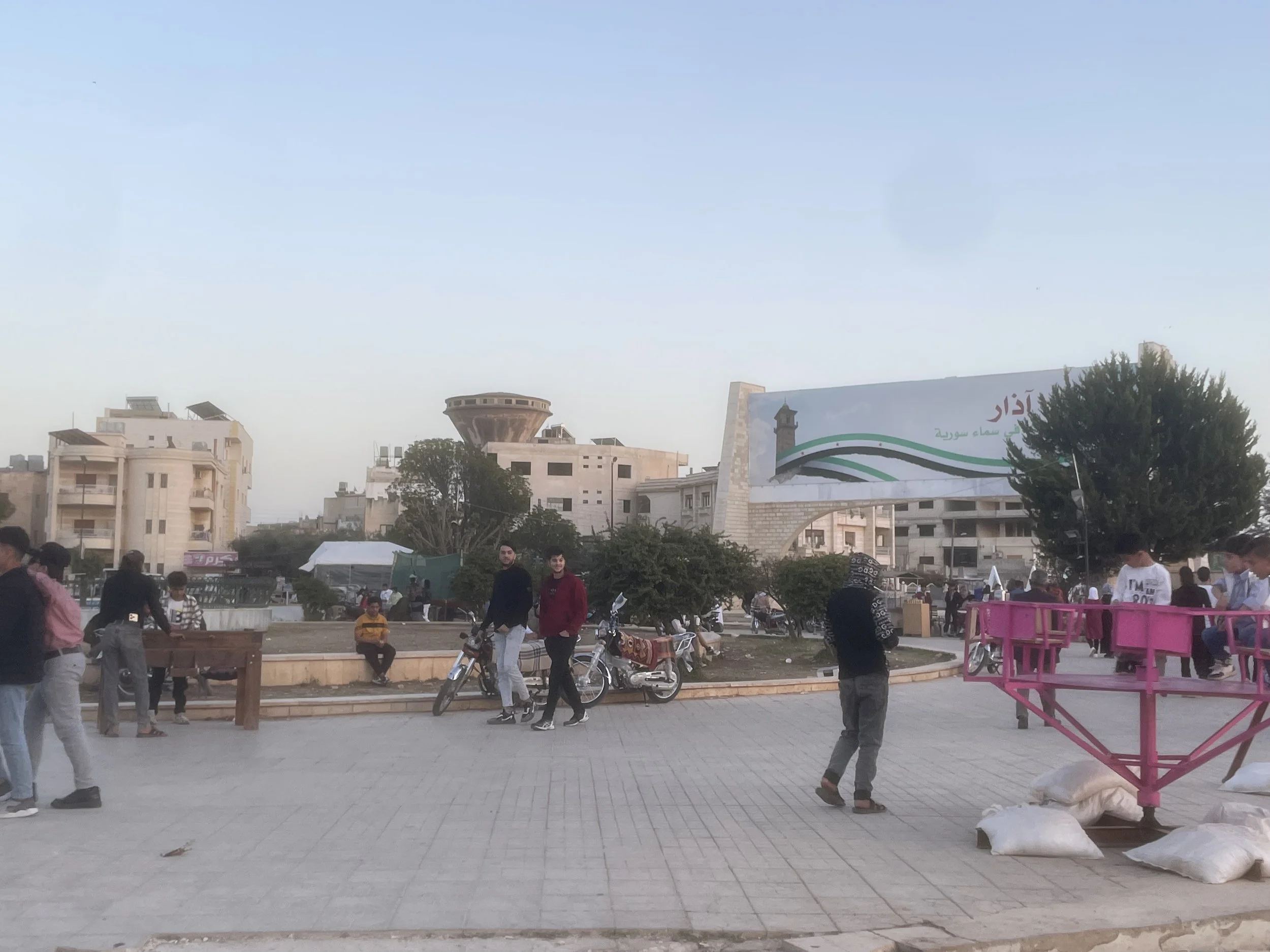
Panorama square, decorated with revolutionary symbols, is bursting with life during the Eid celebration
The death of non-violent protesters only led to a larger mobilization of the local population, with crowds becoming bigger at each martyr’s funeral. The city was soon besieged by the regime security forces, with no one and no food or water being allowed in or out of the city. With the repression intensifying and the regime using heavier and more deadly weapons, local protesters started to organize in armed groups, first to defend the protests, later to defend their neighborhood and town. Daraa quickly became divided between different areas - al-balad , which was liberated and partially besieged until 2018, al-mahata, the center mostly under regime control and partly became a frontline and al-dahyieh, its suburb which was never liberated.
Heavy fighting between the Free Syrian Army and the regime army took place in the city, with the regime army razing to the ground entire parts of Daraa. This photo essay goes back to the history of some of these places for my interlocutors and in-laws.
***
We arrived, my husband, two children and me, in the city of Daraa, fourteen years after the beginning of the revolution, in March 2025. As Mohammad walked us through the streets he knew well as a child, a teenager and a young adult, he brought us first to his parents’ house in the more protected suburbs, before taking us to the places of his childhood and most cherished memories: his paternal grandfather’s and his maternal grandfather’s houses. Trying to remember the landmarks – shops, schools, mosques, family and friends’ houses – that once stood where we now only saw piles of rubble, he guided us through a devastated cityscape from which green shoots of life were already visible, as people had already come back to live in destroyed houses.
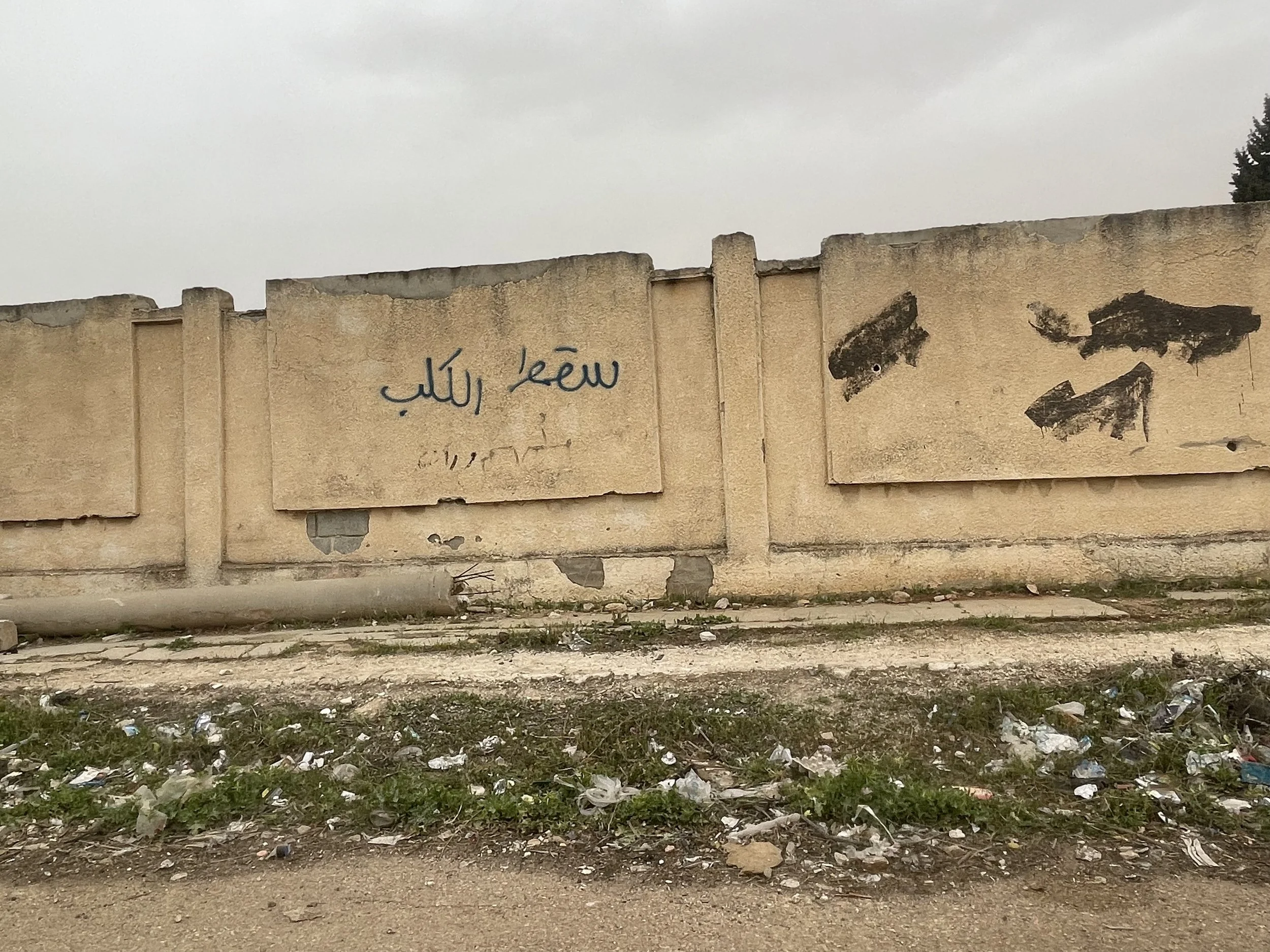
Local school’s wall in al-dahyieh ‘the dog has fallen’
Upon arriving in his parents’ neighborhood, the suburb (al-dahiyeh), where the family had moved a few years before the beginning of the revolution, we see on the walls of a local school traces of the optimism that has come with the downfall of the regime. On this wall, where other writings appear, someone has written “the dog has fallen”, referring to Bashar al-Assad. On nearby walls, the same person has written “Sarout” – in homage to the former football goalkeeper turned revolutionary hero and symbol; and also “cursed be your soul ya Hafez”, referring to the father of Bashar. Another writing, from a different hand, reads “Freedom 8/12/2024”.
We arrive at Mohammad’s home, which is the only family home that belongs to his paternal grandfather, that wasn’t heavily damaged in the armed conflict, given that this area stayed under regime control for nearly the entire decade. It was, however, besieged in 2011, and his mother and sisters remember vividly the women’s protests, and the solidarity between neighbors to survive as long as possible on food and water reserves. Signs of war are not visible in this part of the city, though, if it is for the interrupted construction of houses where heavy carpets and UNHCR plastic tarpaulin have replaced doors and windows and the total abandonment of the commons: the streets are full of plastic and waste. Another example can be found in the family garden, where shells were turned into plant pots. Mohammad’s mother explained that when she went to visit her father-in-law weekly at his home, which was located on the front line, she collected some of these shells and used them to grow small plants, transforming them into decorative items. “I turned death into life” she tells me, smiling.
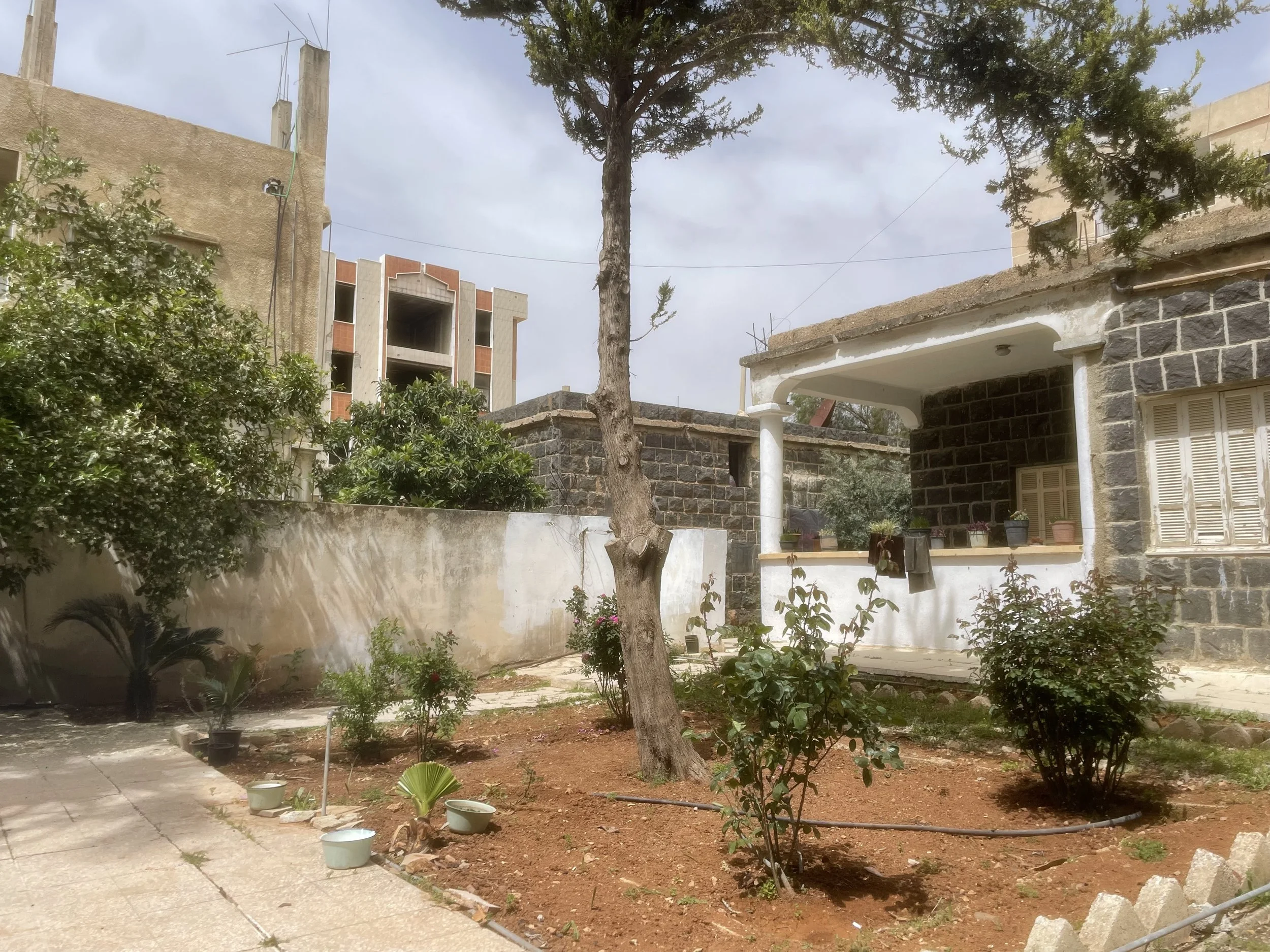
The grandfather’s house
Our next stop is Mohammad’s grandparents’ houses. One of them is still standing, as his grandparents, then in their eighties, had refused to leave even though their home was in the non-man’s land leading from al-mahata and al-balad. The army had tried to scare them away numerous times, but they stayed put in the home they had built decades ago, and that had seen the birth of their five children. On one of these occasions, an army soldier pointed his weapon on the elderly man threatening to kill him if he did not leave his house within the next hours. The grandfather, as his son reported, put the barrel of the weapon on his chest and told him “shoot me now because I won’t leave my home”.
This house, however, appears as a tranquil haven within these destroyed surroundings. It was located a couple of metres after the army checkpoint and found itself in the crossfire of the regime army and the Free Syrian Army. Every evening, one of the sons of the elderly couple came to bring them food and other essentials, and stayed with them overnight to ensure their safety as well as they could.
Mass grave in a collapsed home
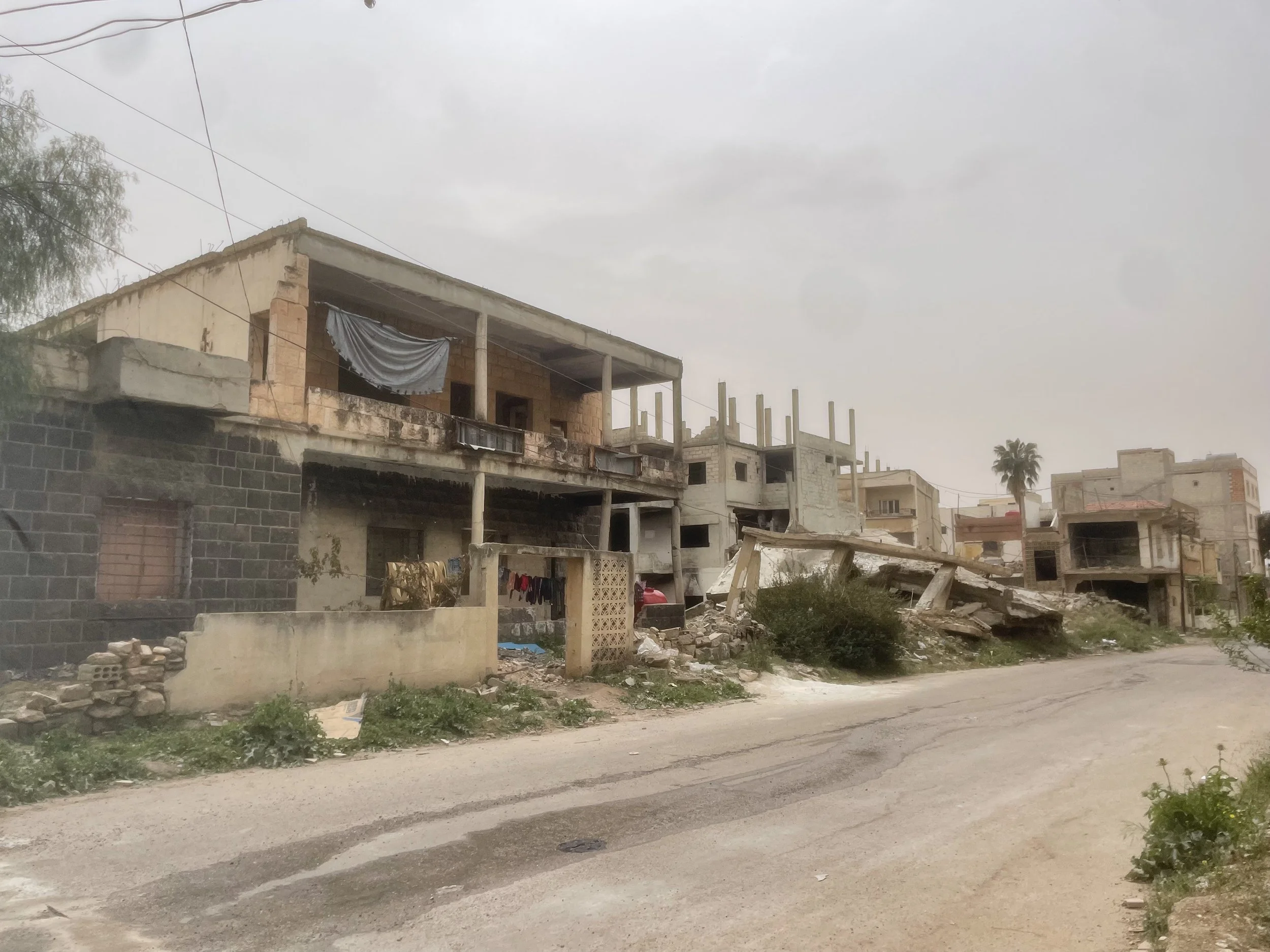
As we walk out, we reach only as far as the first street before Mohammad tells us to look to the right. He shows us a collapsed building: his great uncle’s home that has been razed to the ground by the Syrian army. His father recounts how the building had been used by the regime as a mass grave – they had piled up corpses of the disappeared in this very building. With time, the smell had become unbearable, which is how people started to understand that corpses were being disposed of here. In an act of collective humiliation and punishment, the regime blew up the house so that no one could retrieve the bodies of the martyrs.
Living ruins
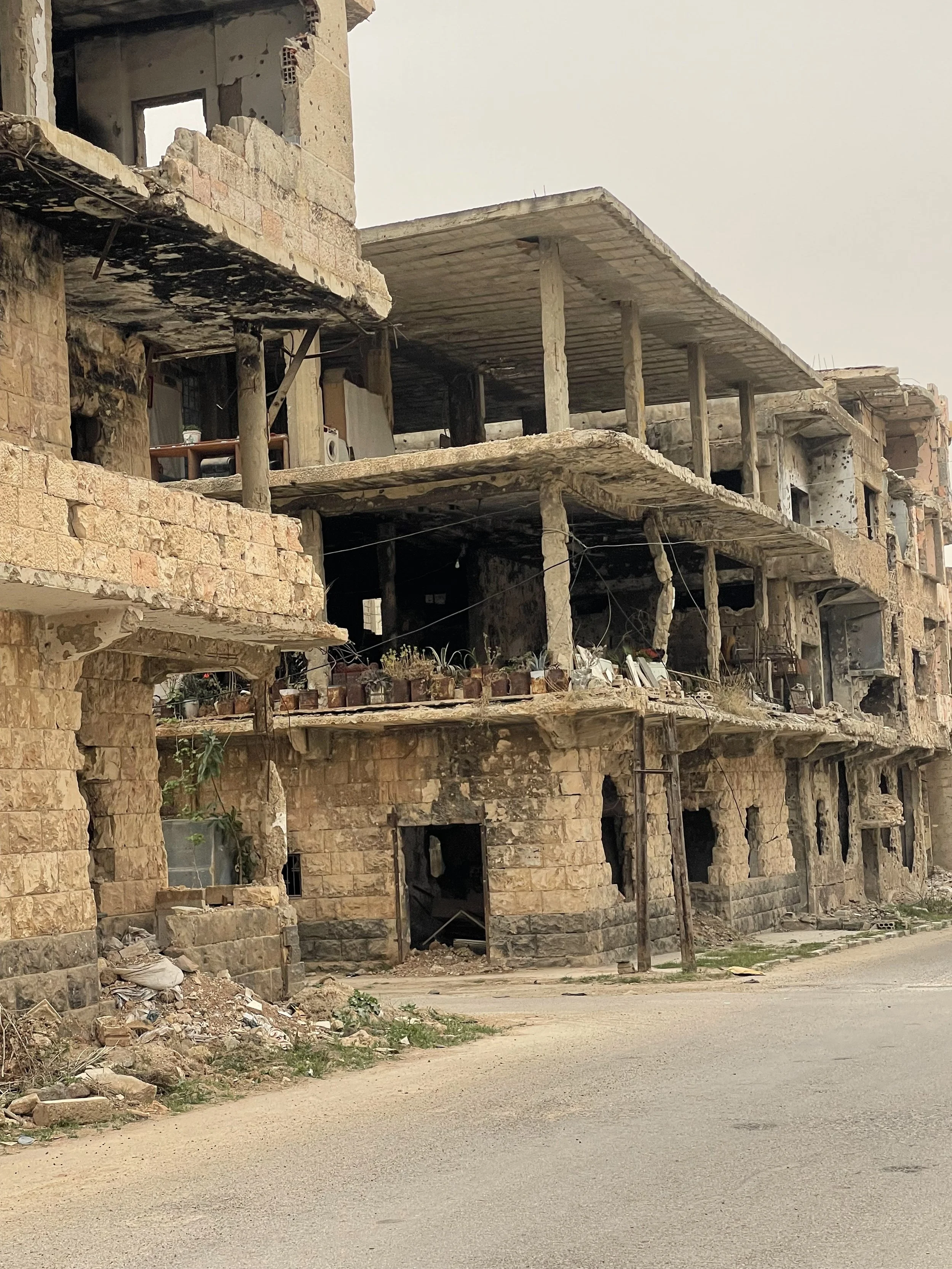
We then continue towards Mohammad’s maternal grandparents’ home. Walking through the ruins of this part of the city, which used to mainly be occupied by businesses and medical clinics, one sees different forms of life coming back. Here in the background, one can see a herd of sheep coming to graze on the grass that is growing back among the ruins. A few apartments are inhabited: people have covered with plastic where doors and windows used to be, trying to insulate their makeshift flats against the cold and hot weather. One can see laundry hanging in the windows, plants on makeshift balconies and sometimes a lit bulb.
Some people have come back to their destroyed homes after the agreement between the rebels and regime army in 2018, making this area an empty zone where internally displaced people could find a refuge despite the situation of scarcity. Here a man has installed a fence around the first floor of the building, as well as some curtains to allow limited privacy, though his living room furniture and washing machine are visible within the half-destroyed building.
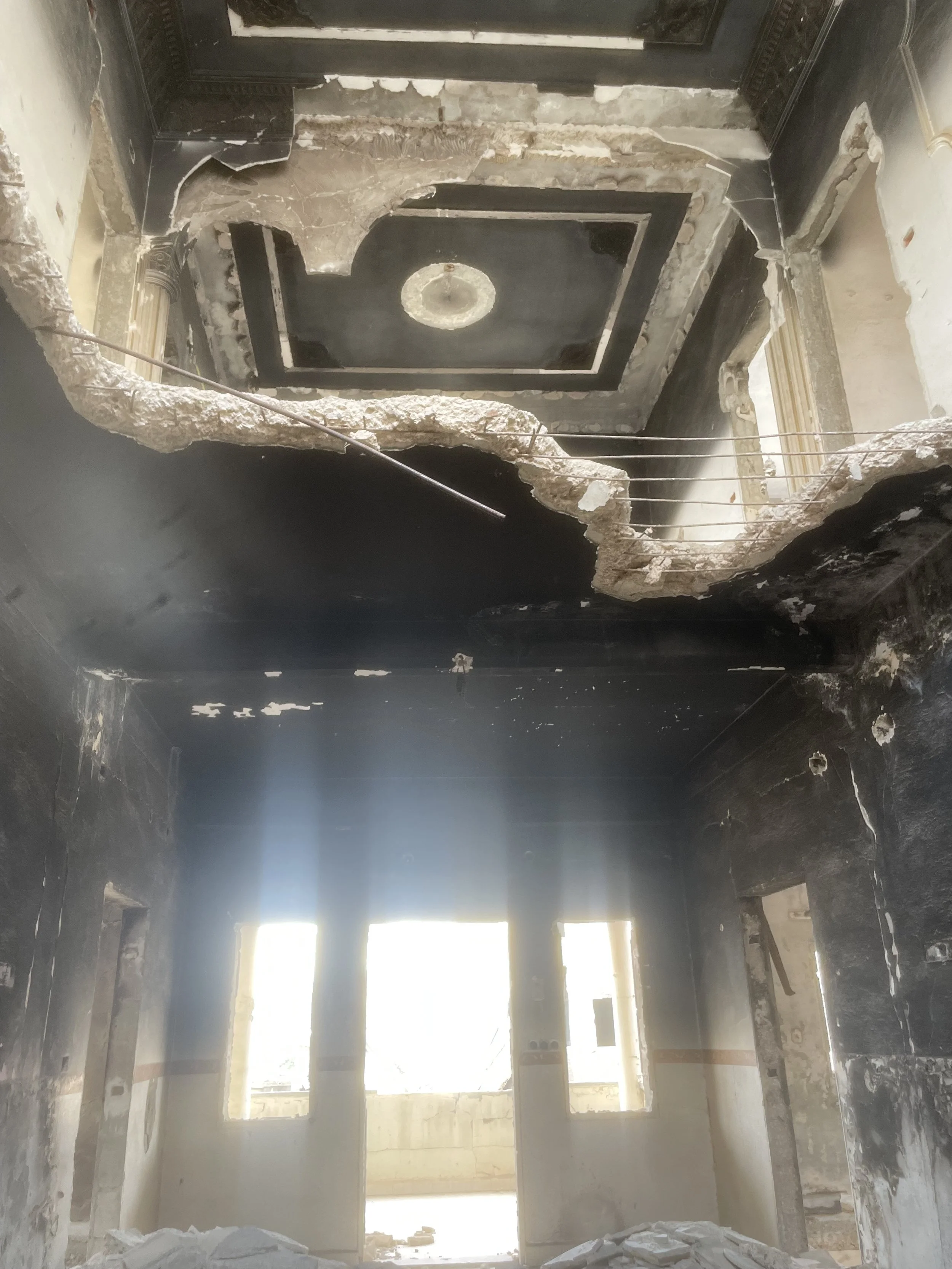
Further down the street, Mohammad tries to remember how he used to get from his paternal grandfather’s family to his maternal one . Some of the streets are still recognizable but not all the buildings. The latter home has been heavily damaged and burned, but the outer structure is still standing and one can enter. The floors have been destroyed, so the only way to go up is by using the external staircases. The floors were destroyed in order to steal the metal wire that ran through them, which was then sold and used to create weapons. We discovered walls blackened by smoke. Inside there is nothing left; everything has been looted. Mohammad’s mother remembers how she had to negotiate with the regime army soldiers to enter the zone and rescue her elderly mother and disabled sister. They could only take a small bag with them containing their most valuable belongings and their official documents.
The burnt house
Quran among the rubbles
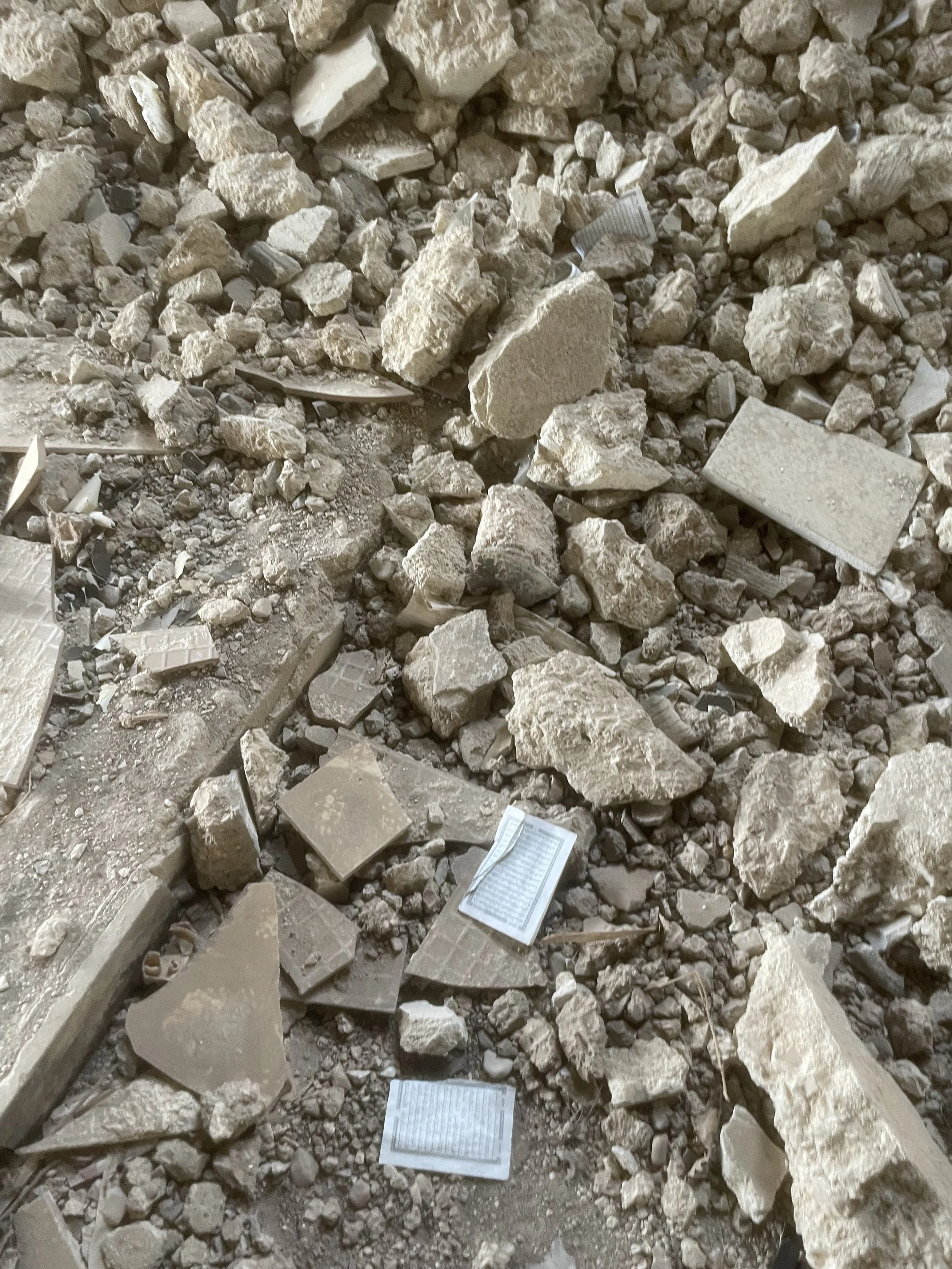
We find an empty building that had been occupied by regime militia, who left their names on the walls and later burned down the place. A paper attracts our attention: it is a page from the Quran. Further down we see the blue cover of a passport. We wonder whose passport it was … It could have well belonged to a family member as they had to leave hastily. Their house was later looted by the regime army and used by different battalions that have left their names and pro-regime slogans on the walls.
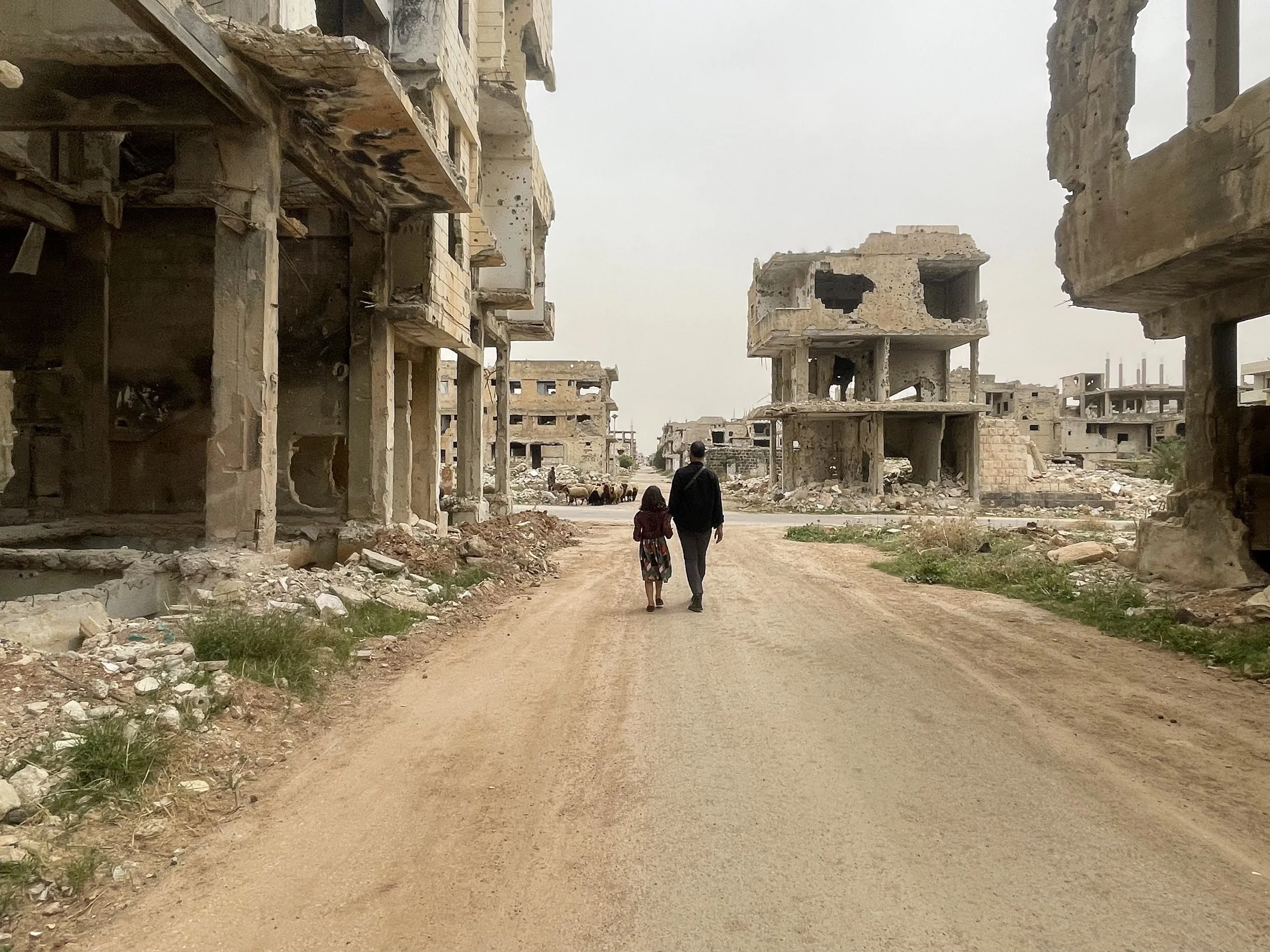
Mohammad walks with our eldest child in the street leading to his grandparents’ house
Coming home after over a decade to a destroyed cityscape, trying to locate the traces of what once had been, is a daunting task. Walking through the ruins with children and seeing other children living in those ruins is both a painful and hopeful experience as one tries to imagine what tomorrow will look like.
After having walked around this deserted part of town, Mohammad brings us on another journey: one that follows step-by-step the one he took on the first day of the protests. From his paternal grandfather’s house to the road towards al-balad, where the protests started at al-Omari mosque.
“We were sitting in the garden, celebrating Mother’s Day – we always do it a few days before the day in my paternal family and after a few days in my maternal one – when we heard a crowd singing and gun shots. We all stood like one man and went to the main door. We knew it had started after we received a few phone calls. I went there with my father and uncles. We took this street and tried to get as close to al-balad as possible.”
We walked in front of the Sheikh Abdelaziz Abazid mosque, of which only the minaret is still partly standing. We are continuing on our way when Mohammad points to the famous street leading from al-mahata to al-balad.
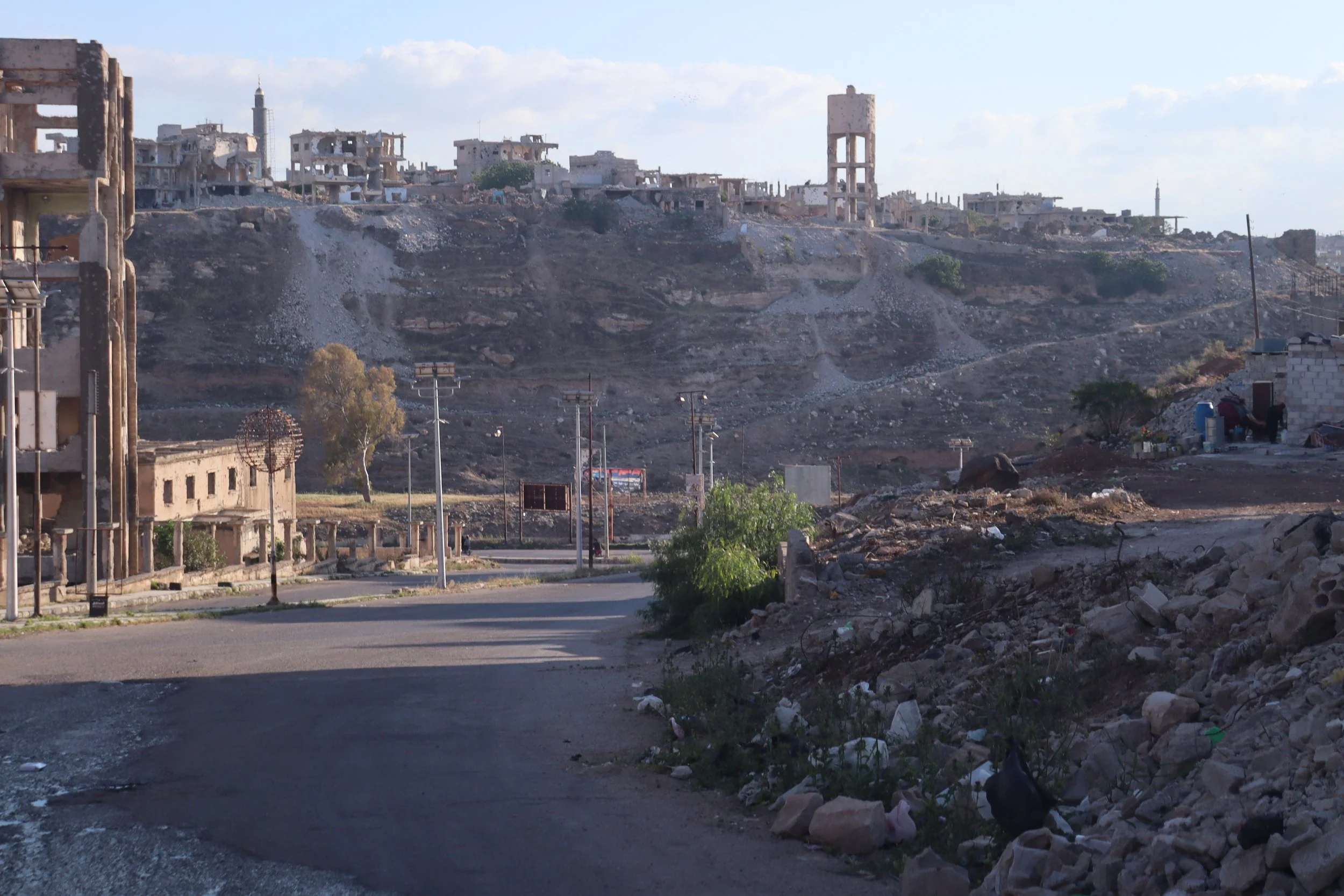
The road to al-balad
This road that goes down from al-mahata and then up to al-balad is one of the streets that has seen the most martyrs fall in the city, as the army had positioned snipers on the high building at its end. Today, al-balad remains the most damaged part of the city: “Here entire neighborhoods have been buried with the intensity of the shelling”, he tells us as he points to the scattered landscape. But there too life is starting to burst again, with many who are returning from other parts of the city and from Jordan. However, people are left to clear the rubble and rebuild their homes by themselves, with the help of remittances from extended family and solidarity networks.
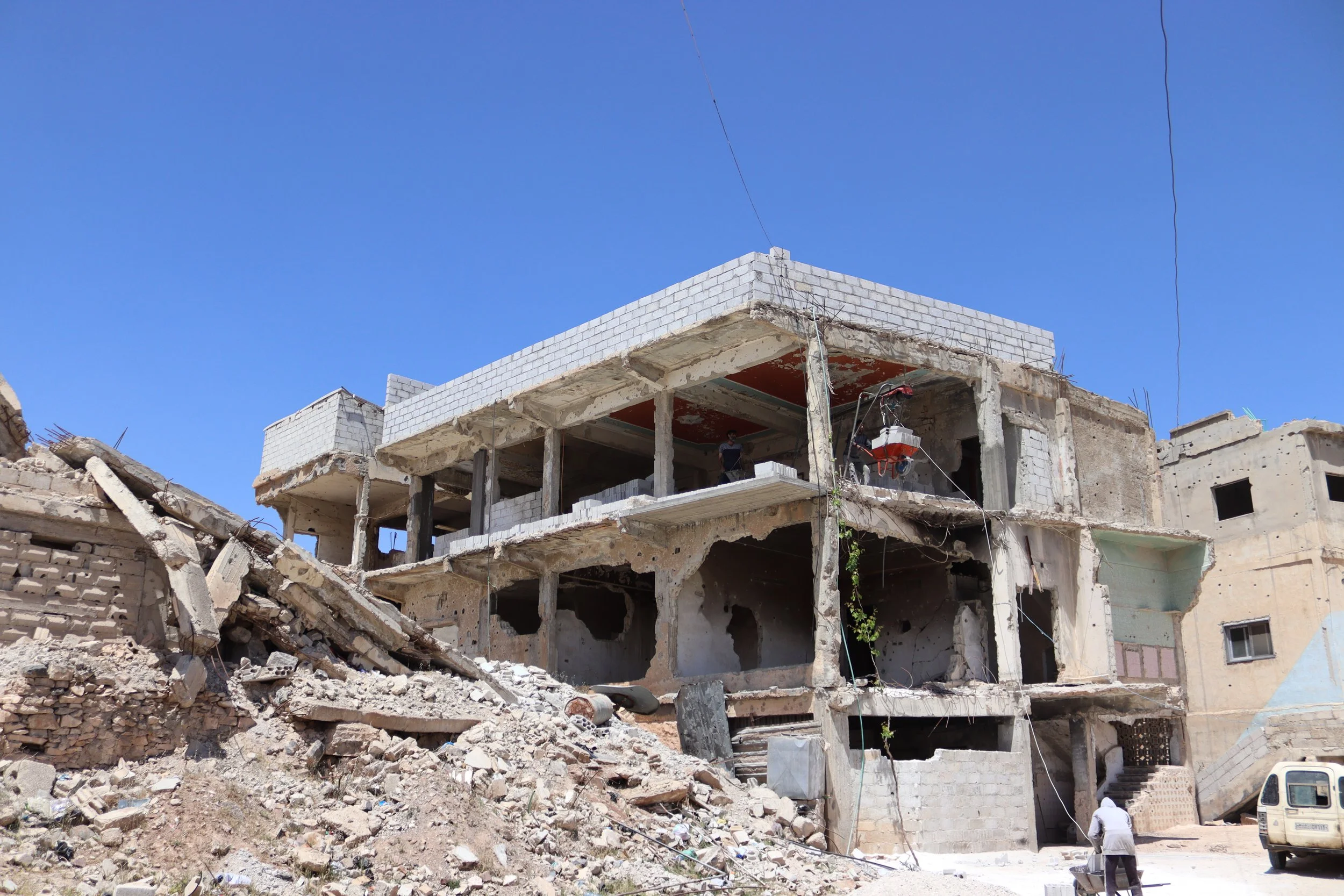
Rebuilding amongst the ruins
A few months after this first visit, Mohammad decided to move back to his city and to renovate his grandfather’s house. On the anniversary of the downfall of the regime, we went to celebrate the city’s and the country’s liberation. This popular celebration brought much happiness to the city with festivities organized in all its neighborhoods and large crowds reliving the hope and release of fear after living five decades under a brutal dictatorship. But a year after the downfall of the regime, if one can see many construction sites, most people who have come back to their destroyed homes live in very precarious conditions, a situation that is worsened by the biting cold at night. A year after the fall of Bashar al-Assad, the city is still slowly trying to rebuild its infrastructures, as well as its everyday and social life in a regained cityscape that is no longer separated by a multitude of checkpoints and where people do no longer fear of being arrested each time they go out of their homes.
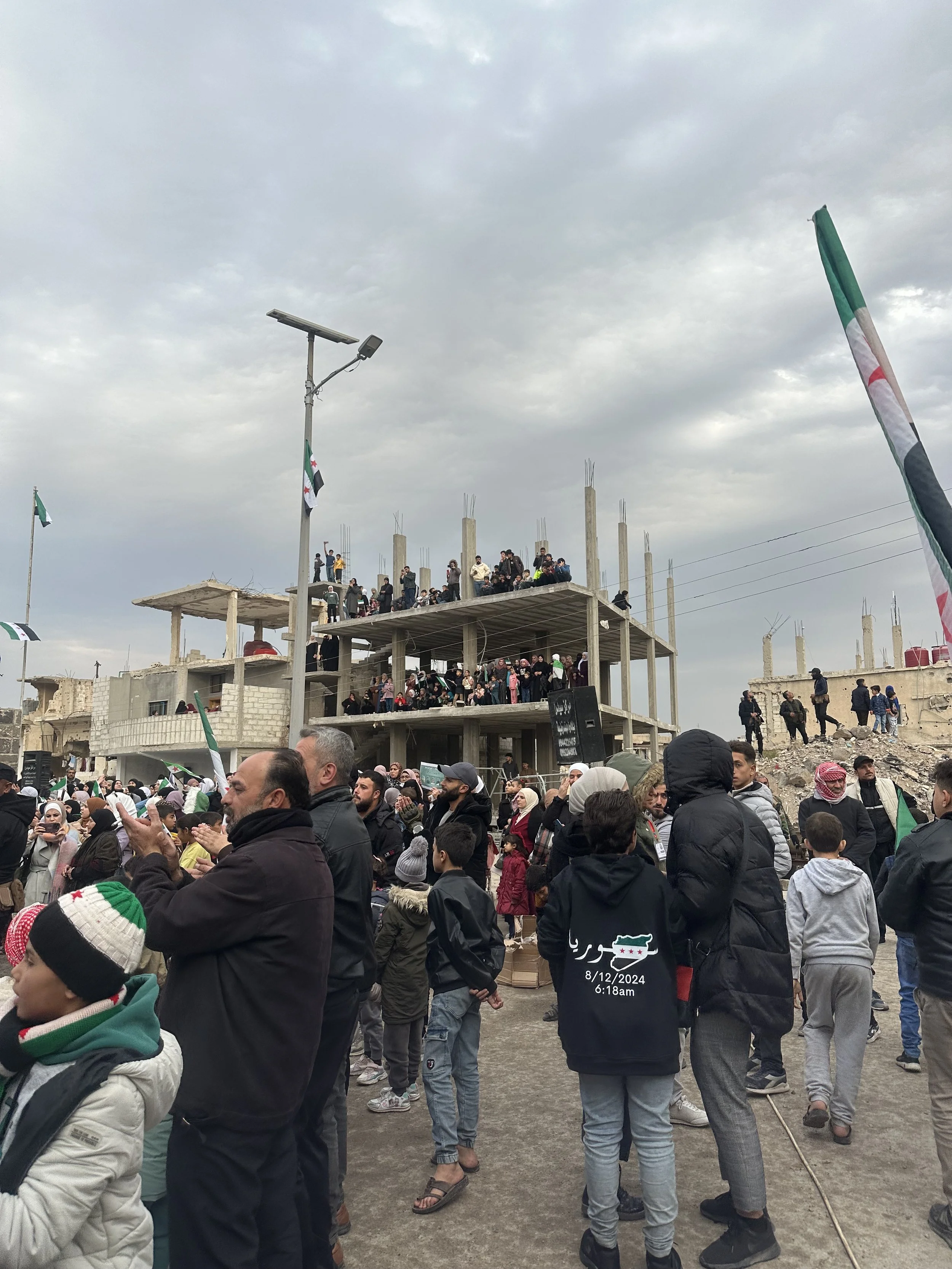
Celebration of the city’s liberation in al-balad
Charlotte Al-Khalili is a Leverhulme Early Career Fellow in anthropology at the University of Sussex. Her work focuses on revolutionary politics and subjectivities, religious temporalities, justice processes and forced displacement in Syria, Lebanon and Turkey. Her research explores the effects of mass political violence and its aftermaths on communities’ lifeworlds. She is the author of Waiting for the Revolution to End (UCL, 2023) and the co-editor of Revolution Beyond the Event (UCL, 2023). She is currently working on a research project looking at local practices and imaginations of justice for which she is conducting fieldwork in Syria.